Thursday, April 7, 2016

Magic Duels Patch Report: Controlling the criticisms

A few month ago, there was simply no way I could have recommended Magic Duels to anybody. It was too glitchy and featureless.

With the new patch for Magic Duels (PC, iOS) making some big changes and adding story content and card sets for both Oath of the Gatewatch and Shadows Over Innistrad, it seems like a good time to assess whether this game is getting the repairs it desperately needed. The big question: "Would I be comfortable recommending Magic Duels to a friend post-patch?"

I started playing Magic Duels for a couple weeks right when it first released, and quickly grew tired with the lack of polish. Setting aside that two of my friends couldn't even launch the game for weeks after release without it crashing, the problems were numerous:
  • quests that wouldn't complete unless you used a shoddy "deckbuilding wizard"-created deck, 
  • no rewards for playing 2-Headed Giant, 
  • rampant game-abandonment because of no incentive to keep playing a game you're likely to lose, 
  • no in-game chat or effective way to contact an opponent during or after a match. . . 

And this was just a short list of missing features. We'll get to the glitches and bugs in a bit.

So, what did this new patch change? Now, when your opponent concedes, you don't have to play against an AI piloting a player's deck all the way to the end to collect your win and coins. This is huge. When you queue up for player versus player, you will not spend half your time playing against doomed AI opponents anymore. Quite frankly, it should have been this way from the start.

That's good! What else?

2-Headed Giant now awards coins when facing random opponents. It's no longer going to be a total waste of time format that nobody plays, perhaps.

With the addition of the Oath of the Gatewatch and Shadows over Innistrad story modes, both of which will take around an hour for a skilled player to complete, the story now has enough gameplay to occupy you for 5-6 hours for free and the combined "starter box" cards you unlock from completing all the campaigns gives you more deck building options should you decide to stay around for the long haul and start playing against humans online.

Sadly, accounts still don't share between iOS and PC. This likely will never be changed because some customers have already paid into accounts on both platforms, and will continue to be a reason to not bother with Magic Duels for the foreseeable future.

More importantly, the patch seems to have added just as many bugs as it removed, if not even more. Here's the patch notes list just of the KNOWN bugs, and the /r/magicduels subreddit is already exploding with reports of new and exciting glitches.

Of course, if you want to play the same magic people are playing in the real world, all of this is a moot point. The card set doesn't actually match real-world Standard.

Magic Duels is still feature-threadbare compared to Hearthstone, but that's unfortunately not surprising. I can recommend the story mode to nearly anyone because it's sincerely 100% free, with nothing hidden behind a paywall. For any player vs player action, however, you play at your own risk. This newest patch has not changed that; the game has been out for many months now and the development team is perpetually behind schedule on fixing glaring issues.

Tuesday, April 5, 2016

Shadows Over Innistrad Prerelease: The Good, The Bad, and The Ugly


I recently had the pleasure of attending two Shadows Over Innistrad pre-releases, the newest set for Magic: the Gathering. For those not in the know, the format of a pre-release event is always Sealed Deck. This means each player opened 6 packs of the new set (+1 random rare promo card) and constructed a 40 card deck using only those cards and basic lands provided by the shop.

There were some memorable back-and-forths, dramatic blow-outs, and weaselly under-performer cards. Here are some of the mental notes I took as I played, in the time-honored tradition of The Good, The Bad, and The Ugly. Note that I'm only mentioning cards with which I had personal experience.

THE GOOD


I didn't even open any copies of Archangel Avacyn, but I played against a few and  I am pretty sure that this card is good. Look at the text box on that thing! It's going to take you a solid minute just to read everything on both sides and absorb the information. You can be certain that well-running decks the country over were particularly likely to be packing a copy of Avacyn.


FLAVOR VICTORY: I cast Anguished Unmaking on an opponent's Archangel Avacyn the turn she came into play. Felt great, and not just because it was my only hope of survival, but because Avacyn is literally being melted by her dad in the card's art. Tough love.

Always Watching: I'm always watching for a good anthem board pump in limited formats, and this is a crazy powerful anthem effect, particularly if you're packing creatures that can block and survive the fight. It fits right in with an aggressive red-white strategy, but I had extraordinary results in a green-white build full of already stocky creatures like my new 0/4 Delirious Fungus Friend, Lambholdt Pacifist, and various werewolves. Just be vigilant about that first word on the card: "Nontoken". Your zombie and spirit friends won't be joining in on the fun. They'll just have to watch.


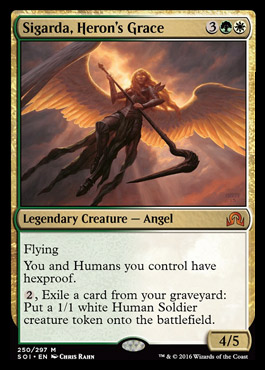
Sigarda, Heron's Grace: Add Sigarda to the list of creatures that cause opponents to panic the moment she hits the board. 
She doesn't protect herself except in fringe cases of opposing Diabolic Edict-style effects, but if she sticks to the board, the win is nearly inevitable. Swinging for 4 in the air and then turning the graveyard into brave chump blockers until the win is a line of play that's going to drive removal-light decks daffy for many months to come. An unfortunate friend of mine faced an opponent packing not one but two Sigarda, Heron's Grace. Even more unfortunately, I was not that opponent.


Wild-Field Scarecrow: The only thing scary about this scarecrow is how good he is. I had two copies for my GW delirium deck splashing red for a copy of Nahiri, and he consistently did work. He's a 1/4, so he makes a great blocker against aggressive decks. When you feed him 2 mana, he explodes into 2 basic lands for your hand and puts an artifact and a creature into your graveyard to turn on delirium, which can act as an (admittedly on-board) combat trick. I used him to fix for a missing color, hold the line against aggro, and enable delirium several times each across just 5 rounds. The power level on this guy really came out of left field for me.

Angelic Purge: Unlike the movie, this card is amazing exactly once per deck. It hits all three most-relevant card types in limited formats and exiles it (preventing delirium), which is pretty much the best a removal spell can aspire to be at common aside from being instant too. You can use the sacrifice to put another card type in your own graveyard for delirium to boot, such as a land. The cost becomes prohibitive to pay a second time in a single game, but I'm going to run two anyway if I open two.


Rabid Bite: A+ for the art alone. 


Moldgraf Scavenger: This is exactly the type of common I love. He starts out as a great wall for a deck with a few heavy hitters at the 5 and 6 drop slot, and if you can scavenge up enough delirium enablers, you are rewarded with a creature that is functionally way above curve, and at common rarity you could conceivably have 2 or 3 of these guys. I expect him to validate green+something delirium as an archetype almost entirely on his own. Also pairs great with our new scarecrow friend pictured above.


Kessig Dire Swine: You can be a big pig too! It's not flashy or exciting, but as far as big dumb green common beaters go, this is my favorite of the last few sets. By the time you're slamming 6 drops, you're fairly likely to have delirium online, and trample is a big deal on a 6/6. If you untap and can swing with this guy, then your opponent's chances of winning look dire. 


Ghoulcaller's Accomplice: A bear with substantial upside in black? Great! Works well in a "cares about humans" white/black deck, but can answer the call in any deck playing black pretty comfortably. 


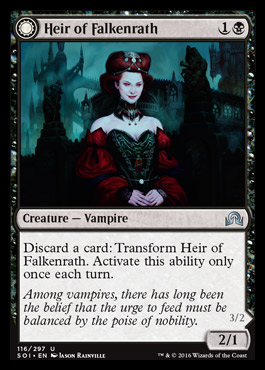
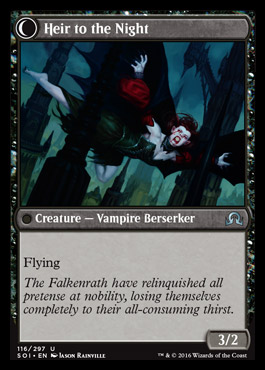
Heir of Falkenrath / Heir to the Night: Against some removal-light decks, slapping an equipment or aura on this vampire and swinging in the air is going to end the game on its own. The heir is perfectly passable, though not exciting, as a 2/1 who threatens a madness card. The fact that sometimes you can use a 3/2 flier to win the game is gravy.


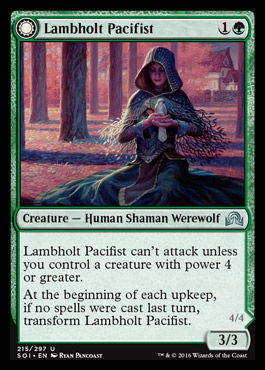
Lambholt Pacifist / Lambholt Butcher: This card can slaughter your opponents at an unfair rate, but she needs a little bit of help. A Gryff's Boon is particularly nuts here: turn 3, you swing with a 4/3 flier. If your opponent has no spell the following turn, she becomes a 5/4 flier, and your opponent is super duper dead. Other auras and equipment are equally acceptable ways to "convince" her to swing. 


THE BAD


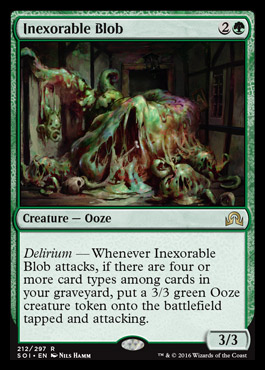
Inexorable Blob: I want to clarify that this guy isn't actually "bad", persay. He's a 3/3 for 3 mana with only 1 green required, which is a fair rate in any color, although less impressive in green. What I'm more wary about, and want other people to realize, is that you're probably never going to live the Delirious Dream of swinging in with your blob turn after turn, popping out new baby blobs on the path to victory. Besides that scenario requiring Delirium (a task on its own), it would require your opponent to have nothing on board capable of blocking and killing a 3/3. An opponent that meets such criteria is already inexorably losing. Maybe a free blob would help seal that fate a turn earlier, but that's about it.


Prized Amalgam: There's a pretty nice prize for meeting this amalgam's deckbuilding demands, but there are far, far fewer ways to do so at common and uncommon than you might think. The creatures that exile themselves to put tokens onto the battlefield don't trigger the amalgam. If you have the good fortune of getting a Relentless Dead to pair with this guy, then you're probably going to grind out a few wins from that value alone. For the rest of us, this is the Blob again, but with 2 color requirements.

Root Out: This card will feel bad to have sitting in your hand occasionally, but you're going to end up playing it because of how many powerful enchantments and equipment are hanging out at uncommon rarity in this set. Pick one up while drafting if you can as insurance against shenanigans like Always Watching or Slayer's Plate.


Call the Bloodline: I'm going to call this card a trap that leads to deceptively bad lines of play. Turning cards into 1/1 lifelink chump blockers, even low-impact cards, is not something I want to do even for free. Similarly, although this technically enables delirium, compare the payoff here to other enablers like Angelic Purge, Wild-Field Scarecrow, or even that Shard of Glass equipment. There's a hypothetical black-red vampire deck that has enough madness outlets and vampire tribal to justify playing a copy of this card, and I sincerely hope I never play against it, because it would be nuts. Everyone else should avoid this card.


Thing in the Ice: This card is so fun and I totally understand the temptation to play it, but unless it's in your opening hand and goes completely unanswered, the odds of this Thing flipping are low. It's far too easy to build a bad deck for the sake of the dream of flipping this guy, throwing away game after game in the process. This horror is better left on ice.


THE UGLY


Second Harvest: The win-more nature of this card is right there in the name: to have a second harvest, you need to have a first harvest, and I'd say the majority of games you're losing will involve a lack of first harvest i.e. board presence through tokens. I've never been more underwhelmed than I was when I saw this card played against me to zero effect right before my victory. I don't think this card is viable in any format besides Commander because it's so win-more, but I can tell you it's definitely never going to live up to the mana cost in Sealed. Don't put this card in your deck.


Equestrian Skill: Doesn't give Horsemanship, garbage card

(in reality this card is perfectly fine if you have cheap fliers, a lot of humans, a lack of playables, or all three).


Wednesday, March 2, 2016

Magic: The Gathering - Duel Decks: BLESSED vs. CURSED review


This review can be found on the product listing on Amazon. I am re-posting it here with minor modifications.


The BLESSED vs. CURSED duel decks pit two opposite motifs against eachother: the holy and righteous defenders of the light against hordes of undead and their sadistic masters. The decks succeed in fulfilling the "fantasy" of these themes and create relatively even games with compelling decisions for maximizing the strengths of each deck. They also feature a few cards from the upcoming new set, "Shadows Over Innistrad."

However, they fail to provide longtime players and collectors with compelling and valuable reprints. The only card in here that has any chance of being worth more than $1 after this duel deck printing is Geist of Saint Traft, and that simply isn't enough secondary market value for the frugal MTG player. There were opportunities for eagerly desired reprints here that went ignored in favor of playing it safe. History has shown that "duel deck" pairings lacking in value find themselves closer to $10 given a few months. We shall see if Mindwrack Demon (a card from the next set) sees enough Standard play to prop up the value, but I would not get your hopes up.

On to the deck analyses!

BLESSED: This deck is BLUE - WHITE, with a theme of spirits, ghosts, and devoted townsfolk defending themselves from the encroaching darkness. The primary game plan is to stall out the game, letting your undead opponent get in some free early hits in exchange for a solid board position, then following through with some flying creatures to chip your opponent down to nothing. It is also capable of some fast starts with the right draw of cards like Champion of the Parish and Topplegeist, although more than likely the aggressor will be the CURSED deck.

CURSED: This deck is BLACK - BLUE, with a theme of undead ghouls, their necromancers, and demons. The plan is to grind down the opponent via creatures that can come back from the dead, forcing the BLESSED player low enough on health that they have no choice but to defend themselves by trading blows with creatures that they know will simply return. Inevitably, the forces of good will lose if they are forced to make 1-for-1 trades.

Overall, these decks are a great thematic battle and a way to ease players into the themes and gothic atmosphere of Innistrad. The problems are really in the details here: the contents of the decks struggle to justify the price tag on the product. While past entries in this product line have included "money cards" like Remand, there's simply not enough here, not even planeswalker cards (which have a notoriously high price floor). And as usual, the Spindown D20 life counters don't have a corresponding set symbol on them, and the flimsy cardboard deckboxes struggle to *actually hold the full decks*. The product barely squeaks by with 4-stars on Amazon due to the good follow-through on the fantasy of BLESSED vs. CURSED. . . but in reality, I'd give this more of a 3.5 because there are problems with this product that just aren't that hard to fix.

Tuesday, February 23, 2016

Mobile games, Skinner boxes, and finding the fun in setting egg timers

Fig. 1: The foundation of an addictive mobile game
I recently needed a surgery that left me mostly immobile for two weeks. I invested in a Nintendo 2DS ahead of time in order to spend some of my recovery period playing the newest Pokemon game, but in reality a large chunk of my bed-bound time went toward trying out the many mobile games out there on Android devices.

Among the games I tried were:

    • Monument Valley
    • Pokemon Shuffle
    • Alphabear
    • Crashlands 
    • Magic the Gathering Puzzle Quest
    • Commute


I'll put the Electronic Arts lineup of mobile offerings in a separate category:

    Fig. 2: Pokemon Shuffle is not free,
    and neither is anything else on mobile
    • Tetris Blitz
    • Tetris
    • Bejeweled Blitz
    • Bejeweled
    • Peggle Blast
    • Star Wars Galaxy of Heroes
      SimCity BuildIt
The only games in these lists that have an up-front cost are Monument Valley and Crashlands, both around $5. I don't think it's a coincidence that these games feel much more complete and focused on providing a great game than the "free" alternatives.

Fig. 3: After every single game,
Tetris Blitz prompts you to spend
money for more points
if you didn't at the start.
That said, the task of beating down on mobile games for being deceptively un-free is not a new one. Most gamers and non-gamers alike understand that free* games come with many asterisks. 

Why would any developer create a game that doesn't make money? The real challenge for the gamer comes down to finding games that strike a good balance between asking for money and providing a game. 

To find an example of how NOT to do this, just download Tetris Blitz and try playing it more than a few games. If you want to play with the power-ups that far outstrip player skill in score importance, you will use up $20 of power-ups in a matter of a half hour. The game encourages you to do head-to-head score comparison "battles" that mostly exist to take advantage of people's competitive drive in a game where points are purchasable. The lottery-board that offers free game currency is enough to maybe play a single maxed out game every few days, if you remember to play the lottery several times a day, then close the game. Don't forget the ads between everything you do!
Fig. 4: Finishers are where you can
easily double your score. You get
3 games worth of finishers here.
Great value! Only $20!
It's an abusive garbage business model layered on top of a great game, ruining the game but probably making the creators good money.

You can't even play the older standard Tetris app without it prompting you, regularly, to go download Tetris Blitz instead. Perhaps that's because the old Tetris app didn't sell points.

Fig. 5: an actual Skinner box
The fairer of these mobile games rely heavily on setting digital egg timers. For everything. Particularly timers for your lives and timers for dispensing free in-game money, which is typically separate from paid in-game money. It all comes down to a simple concept that many college graduates learn about in an introductory Psychology class: the Skinner Box.


It's easy to think you're having fun with these set-ups, but realize that they're only a source of stress after you've spent enough time away from them. Some games are almost entirely a complex web of operant conditioning, with dazzling lights and "unlockable" items and currencies feeding into new ways to make a number go up. Star Wars Galaxy of Heroes is the most blatant offender in this regard; your input during battles matters very little compared to "how high your number is", and you will spend a huge amount of your time feeding currencies and items into systems that unlock new ways to acquire currencies and items, all to make that number higher. From my understanding, this is true of a large number of popular mobile games, like Clash of Clans and Boom Beach, compounded by the utter impossibility of remaining competitive without spending money.

Despite all this, I still have fun with some of these games. The key is not to get caught up in an abusive relationship with a game that is just waiting patiently for you to crack and throw $20, even $50 at it. It would be nice if more game developers would spend time in the middle ground. When a game is worth playing without spending money, I'm a lot more inclined to feel good about chipping in a few bucks.


Wednesday, February 17, 2016

Trigger Warning: Learning to live with Landfall

Fig. 1: A great card, if you remember it's there

When I first put Jaddi Offshoot into my Eldrazi Ramp standard deck (similar to this list), I knew, deep down, exactly what would happen. Unfortunately, it happened almost immediately upon bringing the deck to the Oath of the Gatewatch Game Day. . .

I missed a single Landfall trigger, and it cost me the game.

Staring down my opponent's board of angry dudes, I realized that he had precisely lethal damage on me, no matter what I did to defend myself. Sitting there with two copies of Ulamog, the Ceaseless Hunger in hand and more than enough mana to cast one the following turn to stabilize, I had no choice but to concede the win to my opponent.

Fig. 2: A great card, if actually played before dying
Counting up my mana sources after the game compared to the number of times I gained 1 life, it became clear that I had missed at least 1 landfall trigger. The difference between gaining 10 life and gaining 11 life had cost me the chance to climb my way back into the game.

And this was entirely my fault.

There are limitations of a physical card game like Magic that aren't immediately apparent. Casual players of Magic will breeze right past rules violations, and if a player remembers something they missed after the moment has passed, there's always "Takebacksies", "rewindsies", and "I -forgot-that-card-was-in-playsies". In a digital card game, you literally cannot break the rules, so you don't have to worry about forgetting a triggered effect. Your Knife Juggler in Hearthstone will always remember to throw a knife when a minion enters play under your control.

In a competitive environment in a physical card game, an opponent has no obligation to respect your take-backs or slips of memory. In fact, the rules in most cases explicitly state that its your job to remember effects under your control (which may sometimes include things that don't even benefit you!). This is a generalization, but useful to remember.

The moral of the story is that if you go "oh, and I gained two life from my landfall triggers" any time besides directly after playing those lands, your opponent is fully within the rules to say "no, you missed your triggers. Tough luck." Hopefully, they're a bit friendlier about the phrasing.

That's why when I took that exact lethal damage to the face, I was thoroughly dead.

At first, coming from a mostly casual CCG (collectible card game) background and spending many of my formative years playing Magic Online, I felt something next to a grudge toward opponents that made my life difficult over missing a trigger.

Now, I recognize them as another opportunity for a player to express their total awareness of the game state and the elements of the board that work in their favor. When you leave room for player error in a game, that raises the skill ceiling and gives experienced players more ways to earn the win over less seasoned opponents.

Losing this way can be frustrating. Then again, so can losing a game to the opponent's 1-cost healing plant-wall, but I don't hear any complaints from my opponents about that. The solution to my problem was simply to be more attentive and focused the next time I play competitive Magic.


Sunday, November 15, 2015

#22: The Beginner's Guide - Some post-play thoughts

I just wrapped up a play-through of The Beginner's Guide, so it seemed reasonable to resuscitate my blog and put some of my thoughts out there while the gears are still turning in my head.

The Beginner's Guide is the type of game that loses value if you know ahead of time what it is about, in a storytelling sense. It's from the creator of The Stanley Parable, but in many ways it is not, ways that become immediately apparent through the introduction of the game. I believe that the structure of TBG is flawed. Despite that, the ideas it plays with are novel to me as far as gaming themes are concerned, and should ring true to anyone doing creative work, for show or for themselves. It is a game exploring art, audience, privacy, depression, and validation from the perspective of one artist relating to another artist.

Because I cannot describe the sequence of events in TBG without reducing its value to the reader, the rest of this post will explore some of the thoughts it gave me, bubbling and churning in my mind in the hour after my play. This language is a bit more academic than I'd typically use to engage with a game, but I suppose it's not a good indie game unless it takes longer to discuss it than it does to beat it.

- - - - - - - - - - - - - -

Most of us assume that art is created with intent to share. No one besides the creator sees art that goes un-shared; how can one even point to an example besides one's own? This only reinforces the notion that audience and art are intrinsically related.

Where many of us go wrong, I think, is in assuming that the art is designed to illuminate something about the artist. I could point to the public-image focused society of our current moment, where flattering photos are social currency and fame is a goal in and of itself. 

A question I'm left pondering is whether an audience member for a work of art has any right to raise his or her voice above that of the work's creator, particularly if the creator elects to not use their voice. Must there be a voice? If the creator doesn't choose to ascribe a public-yet-personal meaning to the work for others to consume, is the only other option letting the audience do it instead? If that is the case, are there situations wherein the creator is better off never showing an audience at all?

The question only becomes more interesting when you consider games as an artistic medium, compared to, for example, a novel or a movie. Games are unquestionably defined by their relationship to a player. What that player does within the confines of the game are part of the art, but the key is that a player is acting within the game world. Anything beyond that, from a consistent game mechanic or even an objective of any kind, is an extension of decisions that the creator, the artist, made.

- - - - - - - -

So what happens when a game is designed with no intent to appeal to hordes of players, yet is still playable? To a creator who is unmotivated by public validation in the spheres of novel writing, filming a movie, sculpting, etc., the exchange with the reader or viewer is not coded into the definition of the medium, though it is often assumed. In fact, what with all this "unmotivated by public validation" talk, I'd say that Ayn Rand would be a great reference point for this train of thought if she didn't also have a pretty strict view of what we can even call art.

There are famous examples of writers whose work went unpublished, or artists whose paintings went undiscovered until their deaths. Do you suppose that, on their deathbeds, they did not see their work as legitimate because they did not share it? I see this as unlikely.

Do you think they did not share it because of a fear of the public's ascribed meanings and the burden of having the public misunderstand the purpose of their work? Or perhaps a fear of presenting work for public validation only to find none?

The idea of an artist creating a specifically a game entirely for themselves as a creative outlet seems to defy reasoning. We assume that games are about us, the user. Without us pressing the buttons, nothing even happens, after all.

- - - - - - - -

Let's return to that idea I started with: the notion that art is for sharing, because any artist who creates without sharing is not visible as the counterpoint. What if an artist made games only as an outlet for themselves? If these were shared against their will, is it the artist's job to justify their work's existence and give it a discernible meaning?

When J. K. Rowling uses a pseudonym to seek public validation in an honest light, that is understandable to the world. It's quite possible this would be seen differently if she stopped releasing new writing to the world altogether, or if this work were shown off without the choice to do so as part of the art.

I don't have an answer to these hypothetical questions because, as many #LiberalArtsDegree discussions end, there is no clear answer. What's more important is that I think I have a clearer understanding of the complexities between art, artist, audience, and privacy. 

An artist is not a product, nor are they, necessarily, the art.

Sunday, July 13, 2014

Book Review: 33 and 1/3 - "My Beautiful Dark Twisted Fantasy"

I’m living in the future so the present is my past


my presence is a present kiss my ass


Our culture is already bored with meta-commentary about the potential effects of the digital revolution. It’s here, it’s everywhere, it’s the water flowing over the gills of the millennial and nourishing an isolated global community of social mavens, prepared to Google-as-a-verb the meaning of the word “maven” at a moment’s notice from a smartphone, tablet, netbook, and eyeglasses. It is no surprise, then, that possibly the most influential musician of the 21st century personifies and embraces the identity-crafting realm of the real-time and connected. It's important that any book about this musician understands the world we live in.


Kirk Walker Graves, author of the 33 1/3 entry for Kanye West’s album “My Beautiful Dark Twisted Fantasy”, assumed the burden of dissecting the eponymous album for this very reason. Why focus an intellectual analysis on an album only four years old, nearly devoid of historical context? The author sends the message that MBDTF is the first album that wraps its tendrils directly into the psyche of a society that treats socializing as preparation for personal celebrity, desiring all things immediately not just due to impatience, but because soon now will be irrelevant. Much like the album and our pop culture, the importance of Graves’ analysis cannot be understated, or delayed.


Graves shows a level of enthusiasm for his work comparable to a toddler with a leaf blower in a realm of endless cotton candy. The book begins by giving one of the best explanations of Kanye, the artist and the human, that I have yet read. It helps the reader place him within the digital culture now pervading the world that I previously mentioned. At times, Graves’ ardor lends the book a zest for cultural context that informs the reader of even the most implacable song-sample or lyrical choice. There is a clear appreciation for sociological an anthropological meaning here as well; the many aspects of Kanye and the individual works within MBDTF are frequently described in terms of America’s love-hate response to His ego and ambitions. If you’ve ever felt there’s a fiendishly clever quality to the production of pop-friendly or nearly-pop-friendly songs like “All of the Lights” or “Runaway”, Graves is more than happy to validate you. In most cases, I found myself a convert.


That is not to say that this issue of the 33 1/3 series is without its faults. It feels that on occasion, Graves digs too deep to strike oil on analyses; it’s important that you agree with Graves on the conclusion that Kanye is intractably intertwined with the music he produces, or else all the talk of Kanye’s narcissism and aplomb in the text can become frustratingly psychoanalytical. However, to Graves’ credit, he generally avoids jargon and thesaurus-bombs in favor of flowery and just-short-of-excessive description, leaving it accessible to most learners interested in all the hoopla about Mr. West.


“My Beautiful Dark Twisted Fantasy” (the book) is a superb look at how our society is feeding the Kanye machine, producing great works of maximalist conglomeration (as well as Yeezus, which even the author admits lacked the initial vitality of MBDTF). When Graves then opens up the machine to give the readers a look at the parts, he proves his credentials. In homage to his imagery-thick writing style, I offer my personal interpretation of his thesis, for you to decide whether or not to read his book:


Kanye is a pop-culture golem accumulating the discarded love and scorn of the public eye, screaming from the mountaintop of public consciousness, Wi-Fi enabled, spotlights overhead, clutching a fistful of forgotten hooks and blistering verse, daring the cameras to look away. He is a one-man 24-hour news cycle channeling the ferocity of a boundless ego, repressed by men in suits in corner offices and sitting at talk-show desks. He’s producer, pariah, artist, child, deity, caricature and soon-to-be-king of pop all in one, and MBDTF is the promise.

Thursday, April 3, 2014

#21: Loadout - Loads of Fun, Like 2001

Loadout has come out of nowhere to become one of the most popular free-to-play games available on Steam. What's it about? What's the draw of another free shooter?


Simple. Over-the-top, Quentin Tarentino-level violence combined with an addictive weapon building system and combat that rewards the bloodthirsty instead of punishing them for leaving cover.


When considering the appeal of Loadout, remember that gaming has changed in the last decade or two. Loadout reminds those of us that can remember 1 gigabyte hard drives of how drastically first person shooters have changed. Games like Quake, Tribes and Unreal Tournament focused on ultra-fast movement, precision aiming and adrenaline-fueled deathmatches. Since then, the FPS genre has leaned toward Call of Duty and Battlefield style gameplay: fast deaths and a gritty sensibility grounded in reality. Loadout flips the table by combining ideas from both styles into a delicious 4v4 layer-cake of guns and more guns while pulling the camera back to a 3rd-person perspective.


The first thing a Loadout player must do is craft their starter weapons. Though you won't be able to do anything too over-the-top yet, you'll have access to options almost as good as anything a longer-time player can craft, if not the same in function.


For example, you can see in the screenshot below that I've crafted a bizarre rocket launcher named via Zoolander reference. Let me break down the most important parts for you:

Six is better than one, ask anybody!

  • Scope: Laser Guidance System - While zoomed in, I project a laser that steers my rockets.
  • Barrel: Hexabarrel - I have six rockets.
  • Damage Type: Pyro - Instead of dealing all of the damage upfront, these rockets have a damage boost in exchange for dealing a large portion of it as damage over time.
  • Ammo Type: Scuttle - The rockets crawl along the ground toward their target, a la Legend of Zelda bombchus.
  • Shell: Bouncy - If they hit a surface that isn't a player, they will bounce in a new direction.

I could easily have made this gun even wackier by having a Salvo trigger that lets me load all six rockets at once, or a flak-cloud dispersal on detonation. Here's the fundamental question: is this gun better than a basic SMG or sniper rifle anyone can craft with little effort?


Absolutely not. In fact, this gun is quite difficult to kill anyone with. Every time you add some zany attribute to your gun, its stats adjust accordingly. And that's one aspect of Loadout: experimenting with weaponcrafting and realizing that you will make a lot of stupid guns. 


Hmmm. . . My scalp feels. . . hot. 
Once you're in game, you've got three movement options: run, dodge-roll, and jump, all of which are highly advised. Jumping after a roll gives you an extra high jump. The landscapes in Loadout seem intentionally designed with high-jumpable elevations and a sticky quality that lets skilled players climb or chain jumps in ways that reward mastery of the maps. 


Each player's gunplay experience will be different based on their weaponcrafting preferences. That said, riddling opponents with bullets, rockets, cannonballs, or lasers is universally satisfying, with a high pitched hit-confirm sound that you will learn to love hearing. Whether you're adjusting for recoil on your Heavy-style minigun or trying to line up the crosshairs on your bolt-action sniper, it just feels right. 


 The modes in Loadout already put some other FPS selections to shame. There's Blitz, where players rush from point to point trying to claim control. Deathsnatch requires the players to pick up a vial left behind by dead players to count the kill, allowing teammates to deny eachother. Jackhammer tasks the teams of 4 with playing capture the flag, except the flag can be slammed into the ground for a massive radius that kills opponents instantly up to 5 times. Think Gravity Hammer from Halo, except better. This twist finally makes grabbing the flag in Capture the Flag fun, and the flag runner dangerous. 
Sometimes, you just gotta stand your ground.


Annihilation, the "competitive mode" (though ranked matchmaking has not yet been enabled), combines all three of the above with an overall point system, a stat-buffing system that accumulates a stat of your choice across the game session, and a final relay-race with the jackhammer that is about as intense as it gets. A+ for creativity.


Excavation places several carts around the map and litters the terrain with blue chunks of crystal; the role of "Excavator" is rotated among team members on each team. This person must run around collecting these crystals and returning them to carts. While carrying, they cannot fire a gun. These chunks of crystals are volatile, and will explode 2 seconds after a few shots, even while being carried. This mode really rewards mastery of the map.


They also recently added Domination, which is a simple 3-hill King of the Hill mode. You've probably seen it before, but it's still fun.

Gruesome death animations are frequent.
One aspect of Loadout I am particularly impressed by is the attention to detail. When you get hit, your character is visibly, disgustingly maimed. But this detail stretches to tiny gameplay quirks: while on fire, rolling puts it out faster. Tesla damage drains shields quicker. Taunting while capturing a point captures it 10% faster, but leaves you vulnerable. Players can shoot down rockets, making slow propulsion but high damage rockets a risky move. The list goes on.


The game is funded by cosmetic purchases for one of three base characters. You can buy boosts that allow you to gain points faster like in many games, but you cannot directly purchase any points for building weapons.


I'm not all praise, though: it can be a disappointment when you realize that certain gun parts or wacky combinations are simply not as good as more tried-and-true arrangements, which stifles diversity. I rarely see anyone using shotgun-style weapons because the melee attack is so strong. Some of the more interesting equipment in the game requires a hefty investment of earned in-game currency to access, leaving fresh players out in the cold against tricks such as disguises or portable spawn points. The game is also limited to 4v4, and certain modes are abysmal on certain maps (Jackhammer on Shattered, for example). And lastly, if you're a fan of military shooters in which a few bullets results in death, you may take issue with the hardiness of the players in Loadout. 


Still, I find that Loadout is one of the most enjoyable shooters I have played in the last several years. With sessions that last fifteen minutes or less and a focus on casual modes that maximize fun, it's the perfect antidote for the gamer who just cannot handle another high-stakes game of Call of Duty or Counter-Strike. It's a free-to-play game that I can recommend to almost any gamer familiar with shooters.

4/5


Sunday, December 15, 2013

#20: Bioshock Infinite: Burial at Sea Episode 1 - DLC Worth Digging Up

Downloadable content rarely receives the same scrutiny as its parent game. It’s not quite taken for granted that DLC is a bad value, but it is certainly a creeping suspicion of the informed consumer. It’s refreshing, then, that Burial at Sea – Episode 1 offers a bite size portion of the main course instead of the tasteless imitation some have come to expect.


Burial at Sea drops the player into Rapture, the underwater objectivist utopia from the first two Bioshock games, right as society seems to be a powder keg ready to blow. You’re still Booker DeWitt, but this time you work as a private detective hired by Elizabeth to . . . well, I’ll stop there. In such a story driven game, the less I share, the better.


The game offers fans of the first two Bioshocks an illuminating glimpse into the day-to-day life inside Rapture before its collapse. Citizens discuss the pressing issues of the day as you walk by, generously heaping story fodder for series vets and setting the stage for those who started with Bioshock: Infinite. Rapture looks noticeably more pleasant when the lights are on, the water stays outside, and hulks in diving suits aren’t trying to skewer you with their drill-fists. Of course, the ugliness is still there, underneath.


The environments are astonishingly detailed.
The gunplay remains benign, with a minor selection of firearms that behave more or less as you’d expect. Luckily, plasmids (or vigors, for those who have never been to Rapture) make a return, giving players a way to ignite, freeze, electrocute, and in general channel their inner Avatar. While many sing Bioshock: Infinite’s praises, I have never found the combat terribly satisfying, especially compared to earlier entries in the series. In a concession to players like me, the “weapon wheel” returns. This simple device allows players to hold all of their weapons at once and switch between them easily on the fly, to my relief. I’m of the opinion that only being able to hold two guns makes sense in some FPS games, but much like it felt anti-fun in Duke Nukem Forever, I felt the same in Infinite.
This scene? Hidden and totally optional.


Burial at Sea – Episode 1 is a campaign that I’ve heard others claim they completed in less than two hours. While I can certainly understand a “point A to point B” playthrough being so thoroughly abbreviated, that is a blistering pace compared to my own. I stopped to absorb every conversation, every environmental detail, every secret. I ended up taking four hours. I imagine the length of a playthrough will vary drastically based on whether one is just playing a shooter or exploring Rapture.


Featuring a fan favorite setting, tried-and-true combat, and even a cool battle with a Big Daddy, Burial at Sea – Episode 1 also sneaks in exposition as far as the eye can “sea” (get it? Sea? Rapture’s at the bottom of the sea. I’ll see myself out). It’s well polished and worthy of the Bioshock name, but could be a bit short for some players’ tastes. To mitigate that, one thing is certain: you’re much better off splurging on the season pass containing all DLC for $20 than paying $15 a la carte for part 1 of Burial at Sea. Now go get it, and try and wrap your head around that ending. 


Sunday, December 8, 2013

Book Review - 33 and 1/3: "Doolittle"

You can barely throw a limited-run vinyl without hitting a band that claims to be influenced by the Pixies. They stand as one of the most brashly innovative alt rock bands even to this day. As Ben Sisario points out in his entry in the 33 and 1/3 series, “Doolittle”, the seminal album by the same name is so irreplaceable that not only is it never duplicated, it’s rarely even imitated. Even bands that proudly invoke the Pixies heritage seem unwilling or unable to display their bloodlines loud and proud.


So then, why did this album released in 1989 by a small alt rock band sell more copies after their dissolution than during their heyday? Why do their stop-go songs sprinkled with nigh-unintelligible lyrics reeking of sex, death, violence and rage resonate so persistently? Sisario, impressively, comes as close to pinpointing the answers as anyone ever may, combining the style of a storyteller and the attention to detail of a historian.


His book alternates from scenes of personal discussion with lead singer Charles Thompson to insightful and incisive backgrounding on the state of alt rock and the industry. Even for readers with not the slightest clue of why they should care about the Pixies, Sisario presents a compelling case for why the Pixies were and to some extent still are avant garde. You don’t even have to like them. After reading and listening to Doolittle, you will at minimum respect their contributions.


Sisario has the advantage of studying and personally speaking with Charles Thompson at a time providing clarity of hindsight. Thompson and his band have since reunited in 2004 for touring and begun producing new music only recently, though with a slightly shuffled roster.


Pixies songs have long perplexed listeners with their lyrics. Thompson explains his inspiration and songwriting process in detail, reaffirming some claims he’s made all along while at other times providing glimpses into authentic meanings. Citing surrealist filmmakers as influences on his style, Thompson might have lost the reader if it weren’t for Sisario’s constant and highly welcome explanation.


While Sisario occasionally includes the terse input of guitarist Joey Santiago, drummer David Lovering had little to offer and estranged bassist Kim Deal seems to have stonewalled any attempts to include her side of the Pixies story. A regrettable exclusion, though it does not noticeably impact Sisario’s ability to explain why the music itself matters. In fact, he admirably avoids mucking most of the book with personal interjection until the very end, where his 121-pages-proven musical chops give him more than enough clout to draw some conclusions.


Readers of “Doolittle” might find themselves surprised, impressed, taken aback, disappointed, or all of the above. It will depend largely on their existing knowledge of the Pixies. Musical pariahs who have long claimed Pixies songs to be overrated strummings behind rambling incoherence might find themselves googling “un chien andalou.” On the other hand, members of the if-you-haven’t-heard-the-Pixies-you-don’t-really-know-about-music-at-all club might find themselves ever so slightly disillusioned. Sorry guys, “Silver” really doesn’t mean anything. Even Thompson himself doesn’t know what it’s about, describing the lyrics as “throwaway rhymes.”


Sisario’s thesis on Doolittle is incredibly approachable, weaving personal encounters of the alt rock-kind with well-researched conclusions and elaboration. He leaves even the completely oblivious with a rock solid grasp of why musically inclined folks can’t seem to shut up about the Pixies, while at the same time satiating alumni with fascinating minutiae and inside stories from the band. I would go so far as to say that this little analysis stands as a necessary companion for any owner of “Doolittle”, an album that will forever mark a paradigm shift in alt rock history.


Monday, December 2, 2013

Music Review: Avicii - True-ly Great

Avicii has made a name for himself ahead of the release of his first full album through a string of hit singles including “Seek Bromance, “Fade Into Darkness”, “Levels” and “I Could Be The One”. Indeed, being personally invited to a weekly residency in Ibiza by none other than dance music king Tiesto himself is a sign you’re on your way up. Luckily for just about everyone, Avicii’s newest album lives up to the hype and delivers (almost) twelve infectiously danceable tracks.


The album opens with his teaser single, “Wake Me Up”, immediately catching the listener with his or her guard down. It’s twangy, it’s country, but it’s still got the up-tempo thump and bump that keeps one expecting something more. It’s a dance song, after all; there’s always something more. Amidst the wobbled strums of probably-a-banjo, pensive vocals belt out between choruses that make any room without a dance floor feel incomplete. “Wake Me Up”, more than any other song on the album, is a foolproof crowd pleaser.


“You Make Me” features a ferociously pounded piano beat paired with standard up-and-down synth, punctuated by sections of falsetto calm. An enjoyable foray into angry 88-key instrumentation, but mostly just above average filler.


“Hey Brother” returns to the fascinating country-dance fusion, opening with over thirty seconds devoid of any variety of synth and taking nearly two full minutes to achieve dance frenzy status. This is an eternity in dance music time. Still, while the horns triumph during the few sections conceding supposed genre of the album, the song drives home Avicii’s unique, uncompromising style. Dance music needs more of that.


“Addicted to You” continues the trend, with throaty female vocals reminiscent of Florence or Adele alongside well-balanced piano and bass. It is at this point that a listener who is not a fan of dance music might realize the feat the album has pulled off: you can just listen to it and tap your foot sometimes, if you prefer. The song transitions passively into “Dear Boy”, where velvety and passionate Lana Del Ray vocals feel as if lifted from a dusty record, placed between now-you’re-talkin’ bouts of dirty, wobbly thumps and synth. A song that pushes all the right buttons, but might be a tad too long.


The anger of “Liar Liar” stands in contrast to the prior moodiness. Svelt female vocal amalgamations alongside Avicii’s new pet piano build the listener up. In chorus, one man’s angry claim summons the only organ solo in recent memory into a dance music album.


A vague flavor of enthusiastic ragtime boogie lingers around “Shame On Me”, with a faster tempo that invites vigorous footwork almost enabling swing dancing, of all things. A merry arrangement of prior-mentioned ingredients are featured here, but overall this song is somewhat stale.


“Lay Me Down” is a throwback, a nod to the days of “Sweet Dreams” and “Stayin’ Alive” being dance floor material. Austin Powers would feel at home. “Hope There’s Someone”, on the other hand, opens with over a minute of emotional, bare-bones female vocal solo, building alongside that piano again into a drop into nothing but vocals, into the final drop that would no doubt cause a frenzy in a live venue if for no other reason than the nearly five minute wait.


“Heart Upon My Sleeve”, while overall dull and lacking vocals, at least offers an attention-grabbing choice on Avicii’s part: angsty cellos find their home in front of standard wubs, ticka-tickas, bonks and synth-waves.


Sadly, the album ends on somewhat of a weak note, with “Canyon” offering a by-the-numbers dance floor beat. “All You Need Is Love” similarly offers fare that’s enjoyable yet forgettable, though it at least has pleasant vocal injections to prevent the album from ending on a completely sober, inhuman note.


Avicii’s first full album, “True”, is somehow accessible while incorporating elements in directions other dance musicians may not have even considered treading, let alone feared. It stops short of greatness at the precipice, but that’s what playlists are for. Your party probably wasn’t going to feature only Avicii anyway, right?

Wednesday, November 20, 2013

Anime Review: Gurren Lagann - My MacGuffin Shall Pierce the Heavens

Gurren Lagann is a strange beast. It’s a 26 episode anime that is self-aware yet sloppy, childish yet undeniably clever. The same studio that created the critically acclaimed half-season anime FLCL is responsible for Gurren Lagann. Whereas FLCL aggressively subverted genre norms to the point of nearly disowning it altogether, Gurren Lagann is not quite as daring. It ends up relying heavily on winks and nods to the absurdity of giant fighting mech animes combined with a blistering pace to keep viewers interested.


The vantage from which one views Gurren Lagann will have a drastic influence on what you see. I have little doubt the show was created for those with an appreciation of (as opposed to disdain for) common anime themes and tropes. Various fighting robots in downright silly designs attack each other with their signature moves while yelling the move’s name in a way that reminded me of watching Digimon when I was eight years old. Characters regurgitate inspirational “good guys win through fighting spirit” babble and “resistance is futile” taunts. No one (well, almost no one) seems to face ultimate defeat when they lose. They’ll be back.


From my perspective, there are three real reasons to watch Gurren Lagann.


The first reason is the pacing. Even if you find yourself predicting the outcome of the episode or even the next five episodes, your prediction stretches further into a story than many shows would dare go in two entire seasons. Just as Gurren Lagann has a hyper-sweet anime flavor, it also has a skim milk sensibility for getting to the point. The story travels outward (figuratively and literally) at an alarming rate, functioning as both an element of the plot and a great way to avoid boring those who feel they’ve seen much of it before.


The second reason to watch Gurren Lagann is the way it subverts expectations. This does not contradict the earlier point about playing into the hands of the classic hero-with-special-abilities-versus-evil plot skeleton; on the contrary, the story relies on the way the protagonist has a special power and drives nearly the entire plot forward using this MacGuffin. Gurren Lagann uses the ham-fisted and full-frontal anime elements to deliver sucker punches at several key points in the series right where viewers least expect it.


As opposed to Game of Thrones, in which it becomes apparent for better or worse that anyone is fair game for any kind of misfortune, Gurren Lagann has some internal consistency issues. Still, it keeps the story fresh and signals unexpected shifts in tone and motivation. These dramatic shifts are why many Gurren Lagann fans will say they loved one portion of the series, but were lukewarm on another.


Finally, Gurren Lagann is an anime for people who like anime. The hero has an explicable power making them better, but they have to grow as a person. Pilots will have long-winded conversations in split-second timespans. Epic fights full of overblown carnage will generally leave anyone important unscathed. Everyone thinks grunting and nodding is a valid response. Events that don’t make sense visually will be explained in completely unapologetic forced exposition. And if you watch much anime, you’ll see that even when events take an unexpected turn, they’re turning from homaging one kind of played-out anime storytelling to another. 


The show knows what it’s doing. It’s just checking to see if you do too.


I enjoyed Gurren Lagann, and I can appreciate what it was trying to achieve. However, after 26 episodes, I had become frustrated and bored with the laziness of the storytelling and the constant stream of nonsensical escalation and plot devices. One can't hold a conversation entirely with winks and nods. I can recommend it primarily because it’s short and because after this review, you should know what you’re getting into: if you don’t watch anime, Gurren Lagann will not change your mind. 

Sunday, November 10, 2013

Book Review: The Cuckoo's Calling - From Wizards to Detectives

“The Cuckoo’s Calling” has received more than its fair share of buzz following the news that Robert Galbraith is actually a pseudonym for J. K. Rowling (which is, itself, a pseudonym). The book is simply too solid to be a true debut, as many critics agreed upon release. As the author of a series so famous and universally loved as the Harry Potter books, it’s no surprise then that Rowling has created an enjoyable novel that scores high on easy readability while still providing quality storytelling that readers crave.


The Cuckoo’s Calling is a lean story. Like Rowling’s previous books, there’s very little fat dangling off the edges, ready to bloat the reader with unnecessary information. This is quite a feat for a 464 page detective thriller, a genre that Rowling had not yet touched and now attempts for reasons unknown. The result is a story that starts where it should start, ends where it should end, and keeps the reader guessing and turning pages the whole way through.


Private Investigator Cormoran Strike is not a man who is friends with good fortune. A leg lost to a landmine in Afghanistan, a rollercoaster romance ending in a wreck, and his struggling business leave him with almost nothing. It’s only when he is approached to reinvestigate the months-old suicide of world-renowned super model Lula Landry that he finds an outlet for his energy. All the evidence points toward suicide, with little information to lean on. He throws himself into this high-profile case that has long since been closed because he desperately needs the money and distraction, but soon finds that perhaps there’s more happening in the high-flying world of the super rich and regrettably famous than meets the eye. His temp that he can’t afford, Robin, brings a contagious enthusiasm for detective work helps keep Strike on the right track and sane.


Rowling makes the shift from the puerile though enjoyable wizard fiction of Harry Potter to the world of the reader, shared by this detective. Removing the whiz-bang of wands and puberty, “The Cuckoo’s Calling” instead offers an edgier, grown-up and worn-down character in the form of Strike that succeeds spectacularly considering how much more practice Rowling has in the realm of coming-of-age and ministries of magic.


As mentioned, Strike doesn’t have much going for him at the outset of the book:


“Other people his age had houses and washing machines, cars and television sets, furniture and gardens and mountain bikes and lawnmowers: he had four boxes of crap, and a set of matchless memories.”


Despite his troubled childhood of frequent free-spirited uprooting and shabby parenting, Strike is a cool, calm, and nearly unshakable figure. With nerves of carbon fiber (because steel isn’t strong enough), he extracts what he’s looking for from witnesses, suspects, family members, and friends-of-friends. Each new encounter is a pleasure to read, as Strike exercises his practiced and perfected art of gathering a thousand little puzzle pieces and fragments of memories from eccentric figures throughout London’s social strata.


From his office in London, Strike embarks on a distinctly modern detective tale. While historically famous investigative thrillers might take place before the advent of the computer or even electric lighting, Strike gathers information with the help of London’s ubiquitous security cameras, smart phones, and Google. Deducing the past with the help of designer brands and records of who-called-who while chowing down on a Big Mac helps lend the drama an air of recency.


Strike’s emotional duress also ensures that our expert detective is a human with emotions and needs. Of course, his stoic avoidance of self-pity both endears him to his reader and keeps him going through a time that would crack most people. In a moment of self-reflection, Strike considers:


“Seven and a half million hearts were beating in close proximity in this heaving old city, and many, after all, would be aching far worse than his.”


“The Cuckoo’s Calling” is littered with “Strikisms”, little observations of human nature and the modern world vaguely pertaining to the case. His thoughts, even unspoken, always reveal themselves in the calm and clinical verbiage of a detective accustomed to considering and including all available information:


“Couples tended to be of roughly equivalent personal attractiveness, though of course factors such as money often seemed to secure a partner of significantly better looks than oneself.”


The story tightly follows a theme of social class, income and privilege. Strike himself has a complex background reaching both up and down the social ladder. Each person he interviews is clearly represented as having their own unique destitution or opulence, each placed in stark contrast as Strike alternates from speaking to the homeless to investigating a night club.


And yet, Rowling (and by extent, Strike) stays refreshingly far away from the temptation to editorialize about the superior lives that the wealthy and famous live. If anything, it makes clear the toxic nature of fame and money on both those who seek it and those who have it. As Strike ponders:


“How easy … to capitalize on a person’s own bent for self-destruction; how simple to nudge them into non-being, then to stand back and shrug and agree that it had been the inevitable result of a chaotic, catastrophic life.”


The story breathes life into London as Strike walks down Charing Cross, takes the tubes, grumbles at construction and grabs a pint. With each new character testimony introduced, readers find themselves slowly piecing together the tragic life of Lula Landry. Disaffected and detached, The Cuckoo’s Calling presents the glitz and glamour of the celebrity life in all of its dismissed irritating details, casting a garish light on our infatuation with rich humans.


“The Cuckoo’s Calling” deliberately defies and subverts many genre norms of crime fiction. Far from a hard broiled detective in a noir world of dames and robbery, it features a protagonist with real problems, real (though stereotypically masculine) responses, and a tragic crime. The suspects, the secretary, everything about the supporting cast doesn’t just fall into a lame trope. It’s down to earth and so is Strike, which is to his distinct advantage in his investigation.


The book may be lean, but it also sticks insistently to the kindergarten advice of using words instead of violence. In our day to day lives this is excellent advice, but in a detective thriller tailored for modern audiences one might expect a bit more action instead of pure, Holmesian deduction. Rowling puts the weight of developing the investigation almost entirely on characterization and conversation for most of the book, and like Strike’s hulking frame on his prosthetic leg, carrying such a burden for so long can cause irritation.


Without giving away too much, I also found the conclusion of the story to be unsatisfactory. After putting so much effort into making a detective novel fresh and exciting, it felt like a cheesy about-face.


Taken together, “The Cuckoo’s Calling” is a modern detective story about fame, fortune, and family ties. It’s not a heavy read, it features “tell me more”-worthy characters, and it’s all tied together with that inherently suspenseful IV drip of clues for the case. While some might complain that they expect more zip-bang-pow action for their buck in crime fiction, I think the book is more palatable, interesting, and universally enjoyable as a result of the shifted emphasis.


Despite the few disappointments, I still like the idea of a sequel with Cormoran Strike. If Rowling grew as attached to the characters as I did then perhaps she will oblige.